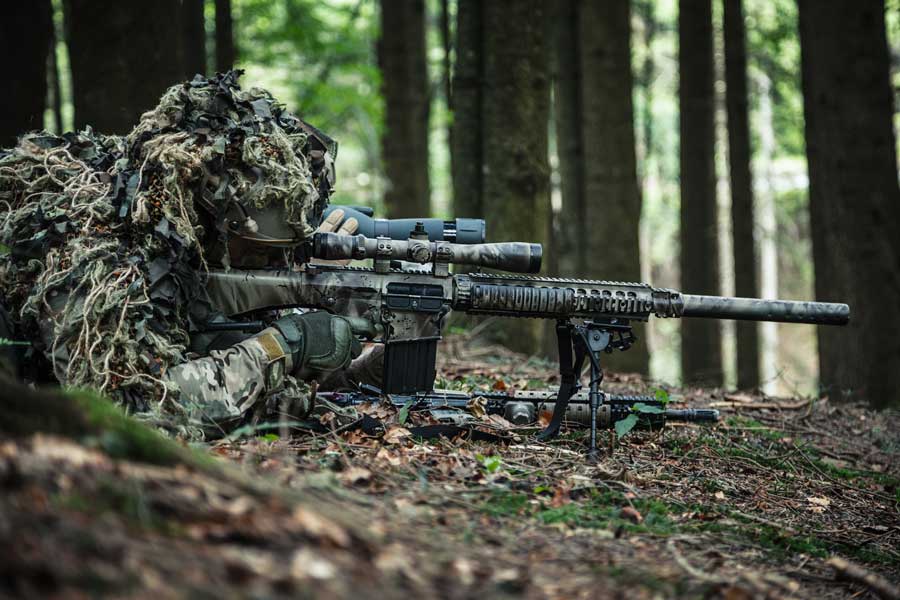

After the experience of the Second World War, the U.S.A. also realised the importance of camouflage for troops in modern battlefields. This guide traces the major evolutions of the U.S. Military Camouflace through the decades and the most significant war events.
Table of contents
U.S. Military Camouflage evolves after WWII
Camouflage is one of those details that can tell a story before you even look at the weapon, the patches or the equipment. A certain combination of green and black can immediately suggest Vietnam. A digital woodland pattern points to the early 2000s. A mix of brown, green and muted tan brings Afghanistan to mind.
For airsoft players, this is more than a matter of aesthetics. Understanding US military camouflage patterns also helps when choosing equipment for a real playing environment, because colors, materials and uniform cuts can make a noticeable difference in woodland, arid/rocky or urban games.
The history of American camouflage is surprisingly varied. The U.S. Army, U.S. Marine Corps and Special Operations Forces did not always follow the same path. Sometimes a pattern was officially adopted. Sometimes it was simply tolerated or locally produced because operators liked it. And sometimes a pattern that seemed promising on paper became unpopular once soldiers actually wore it.
If you enjoy the historical side of airsoft, the choice of a pattern becomes an interesting starting point because it reminds us that camouflage has always been about matching equipment to a particular environment.
Vietnam: when camouflage became part of the Special Forces identity

As early as World War II, the Marine Corps had used a camouflage pattern for operations in the Pacific but before Vietnam, the standard U.S. combat uniform was generally based on solid colors rather than the patterned camouflage we now associate with American troops. Vietnam changed that. Dense vegetation, broken shadows and short observation distances made jungle camouflage much more interesting to soldiers operating in specialist roles. The Army's own historical material notes that the ERDL pattern was first used in Vietnam in mid ‘60s and that it was initially worn by Special Forces and other special operations personnel.
But the most famous pattern of the period was not actually an official U.S. Army pattern.
That pattern was Tiger Stripe.
Tiger Stripe developed from Southeast Asian camouflage traditions, with roots in French and South Vietnamese patterns. American advisors working alongside South Vietnamese formations could wear locally used uniforms, and U.S. Special Forces personnel soon became major users. The pattern was made in several variations, with narrow, irregular stripes in combinations of black, green, brown and olive.
Tiger Stripe was designed around a very specific problem: breaking up the human outline in dense tropical vegetation.
The cut varied too. Many uniforms were locally tailored rather than manufactured from a single standardized U.S. specification. Fabric could be cotton twill or other locally available materials, and pocket arrangements were not always identical. This variation is actually part of the charm for collectors and reenactors today.
The 5th Special Forces Group became particularly associated with Tiger Stripe. The pattern was also seen among reconnaissance personnel, advisors, Navy SEALs and other specialist troops. It became a visual shorthand for the unconventional side of the Vietnam War.
Popular culture reinforced that image. Films such as The Green Berets helped create the enduring visual connection between Vietnam-era Special Forces and jungle camouflage. The stereotype is now so strong that showing a Green Beret in a boonie hat and Tiger Stripe immediately places the viewer in the Vietnam era.
Among US military camouflage patterns, few have such a strong connection with a particular generation of soldiers and a specific operational environment.
ERDL: the bridge between Vietnam and Woodland

ERDL, short for Engineer Research and Development Laboratory, was developed earlier (1948) but entered operational use in Vietnam during the late 1960s. It used a four-color "leaf" arrangement of dark green, light green, brown and black. Unlike Tiger Stripe, it was an actual U.S. military-developed camouflage pattern. Its appearance has changed slightly in terms of exact coloration over the course of 30 years; the most distinctive form is probably the lime-green-dominant one, nicknamed "Lowland" by collectors.
ERDL is important because it became the visual ancestor of the famous Woodland pattern that would dominate American combat uniforms for decades.
Early ERDL uniforms were associated with specialized troops rather than immediately replacing the olive-drab uniform throughout the Army. In other words, camouflage gradually moved from being a specialist solution to becoming the normal American combat uniform.
1981: the Woodland BDU becomes the American standard
The big change came in 1981, when the U.S. Army introduced the Battle Dress Uniform, or BDU, in the temperate Woodland pattern. The Army's historical documentation describes the BDU as a forest-colored pattern with infrared-reflective properties and reinforced elbows, knees and seat. The original fabric was a 50/50 cotton-nylon blend.
The Woodland pattern was not simply ERDL copied onto a larger scale, but the relationship is clear. The familiar four-color combination of green, brown, black and lighter green became one of the defining visual signatures of the American military from the 1980s through the 1990s.
The BDU cut also mattered. The coat featured practical chest pockets, adjustable cuffs and a relatively loose field fit. Trousers had cargo pockets and reinforced construction. Later versions and fabric weights were adapted to different climates.
This was the era when the logic behind US military camouflage patterns became particularly clear. Woodland BDU belonged to a generation of military clothing designed around outdoor field operations, forests, temperate terrain and long periods spent moving through vegetation.
The pattern became almost universal across American military culture. Army units wore it. Marines wore their own woodland camouflage utility uniforms. Reserve components wore it. Military schools and specialist units used it. It appeared in photographs from Grenada, Panama, the Balkans and countless training exercises.
Hollywood did the rest.
Movies from the 1980s and 1990s turned Woodland BDU into the visual language of the modern American soldier. It became almost impossible to see a woodland uniform without thinking of the ending part of Cold War, or the countless military films of the period (Did someone say "Gunny" by Clint Eastwood?).
For airsoft, Woodland is still one of the easiest patterns to integrate into a loadout because it has such a broad visual identity. A BDU-style shirt, matching trousers, olive or woodland equipment and an appropriate head covering can immediately create a convincing late-Cold-War or 1990s impression.

Six-Color Desert: the “Chocolate Chip” era
If Woodland became the visual signature of the Cold War U.S. soldier, the Six-Color Desert pattern became one of the most recognizable American camouflage designs of the early 1990s. Officially associated with the Desert Battle Dress Uniform, or DBDU, it is much better known by the nickname “Chocolate Chip.” The name comes from the small black and off-white shapes scattered across the pattern, which reminded American soldiers of chocolate chips in cookie dough.
The pattern itself was developed with rocky desert terrain in mind. Its palette combined sand and tan with two shades of brown, pale green and the distinctive black-and-off-white “rock” shapes. That made sense in the American desert environments used during development, but the pattern was not equally effective everywhere. Large areas of open, sandy terrain in the Middle East exposed some of its limitations.
Its moment in the spotlight came with Operation Desert Shield and Operation Desert Storm. The U.S. Army and Marine Corps deployed large numbers of personnel wearing the Six-Color desert uniform, making the pattern instantly recognizable to a worldwide television audience following the Gulf War. An official Marine Corps publication from 1991 shows the six-color “Chocolate Chip” uniform as the standard daytime desert uniform for Marines during the operation.
The association did not end with the Gulf War. Six-Color uniforms were also used during Operation Restore Hope in Somalia, another heavily televised U.S. military intervention of the early 1990s.
Three-Color Desert: a more practical answer for open terrain
The limitations of the Six-Color design helped push the U.S. military toward a simpler desert pattern. In October 1990, the Army adopted a new Three-Color Desert camouflage pattern to replace the six-color design, specifically as the Gulf War accelerated the need for more effective desert clothing. The new pattern used a much simpler combination of sandy beige with brown and muted green tones.
This creates an interesting historical overlap with Desert Shield and Desert Storm. The Three-Color pattern was adopted during the buildup to the Gulf War, but it did not instantly replace every existing desert uniform. Six-Color and Woodland uniforms remained highly visible during the conflict, while the newer design was progressively introduced. That distinction is worth remembering when looking at period photographs: seeing a Three-Color uniform does not automatically mean that the photograph was taken after Desert Storm.
The Three-Color pattern became particularly recognizable during the U.S. operations that followed the Gulf War. Operation Restore Hope in Somalia, beginning in late 1992, belongs to the same visual period but also shows the transition toward the newer desert camouflage. The contrast between Six-Color and Three-Color uniforms is especially interesting when looking at early-1990s photographs, because it reflects a military still adapting its clothing system to different environments and operational requirements.
The move from Woodland and desert-specific uniforms toward more specialized camouflage systems also set the stage for another major change in U.S. military clothing: the adoption of digital camouflage by the Marine Corps.
The Marines take a different road: from Woodland utilities to MARPAT

The U.S. Marine Corps followed the same general woodland tradition but eventually developed a much more distinctive identity.
During the 1990s, Marines still used the familiar camouflage utility uniform, including woodland patterns. The change came at the beginning of the new millennium with the Marine Corps Combat Utility Uniform, or MCCUU.
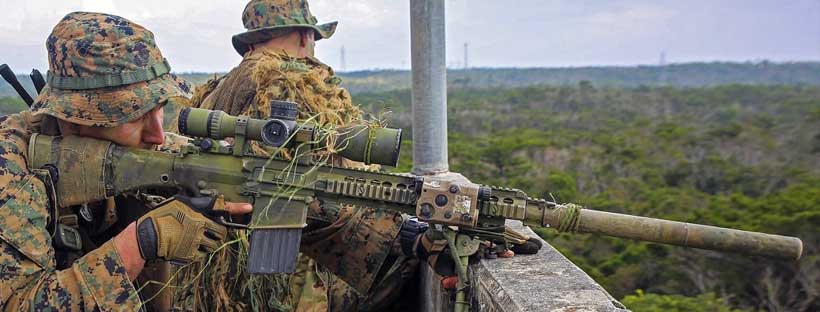
The Commandant approved the new combat utility uniform on June 6, 2001. The design introduced MARPAT, the Marine Pattern, with woodland and desert versions. The new uniform was intended to improve durability and combat utility while giving Marines a distinctive service-specific uniform.
MARPAT was a digital camouflage. At first glance it resembles the digital U.S. Army patterns of the same period, but the details are different. The woodland version uses dark greens, lighter green, brown and black, with the pattern broken into small pixel-like elements.
The cut changed as well. The MCCUU incorporated slanted chest pockets, sleeve pockets, redesigned cuffs and provisions for integrated elbow and knee protection. The fabric included ripstop construction, and the uniform was treated to reduce the need for pressing or starching.
The transition began in 2002 and was completed over several years. By October 2006, the older camouflage utility uniforms had been phased out, leaving MARPAT as the standard combat utility camouflage.
That makes the history of US military camouflage patterns particularly relevant for Marine-inspired setups. Woodland MARPAT is not simply "another green camo".
There is also a practical reason MARPAT works well for airsoft. Its small-scale digital elements break up the outline at relatively short and medium distances, while the dark green palette remains convincing in many temperate woodland environments.


UCP: the digital experiment that did not work everywhere

The U.S. Army took a very different approach in the early 2000s. The Universal Camouflage Pattern, or UCP, was introduced with the Army Combat Uniform in 2004. The ACU replaced both the BDU and the Desert Camouflage Uniform as the Army's standard combat and garrison uniform.
UCP was unmistakable. It used small digital shapes dominated by grey, green and a blue-grey tone. The idea was ambitious: create a single camouflage that could work reasonably well across woodland, desert and urban environments.
The problem was that "acceptable everywhere" is not necessarily the same as "excellent somewhere".
In Afghanistan, soldiers found themselves operating across mountains, dry valleys, villages and patches of vegetation. The Army eventually acknowledged that UCP did not meet all concealment requirements in that environment.
UCP remained visually important for almost a decade. It is now strongly associated with the Iraq and Afghanistan transition period, early ACU uniforms and the distinctive look of the Global War on Terror's first years.
MultiCam and the return to natural colors

As the Army searched for a better solution for Afghanistan, MultiCam emerged as one of the leading candidates. In 2009, the Army tested MultiCam against UCP-Delta in Afghanistan, with one battalion receiving MultiCam uniforms and equipment for evaluation. The Army specifically noted that some Special Forces personnel were already wearing MultiCam.
In 2010, soldiers deploying to Afghanistan began receiving uniforms in the pattern. The pattern combined several shades of green, brown and beige and was designed to transition between different terrain types rather than rely on a single dominant color.
This was a major visual change.
After years of grey digital camouflage, the U.S. Army was moving back toward organic shapes and natural colors. MultiCam became particularly associated with Afghanistan, special operations and the increasingly modular equipment ecosystem of the period.
For airsoft, MultiCam is also an interesting middle ground among modern US military camouflage patterns. It can work in dry woodland, grassland, transitional terrain and some urban environments, but its effectiveness depends heavily on the season. A bright green spring forest is not the same as a dry summer field.
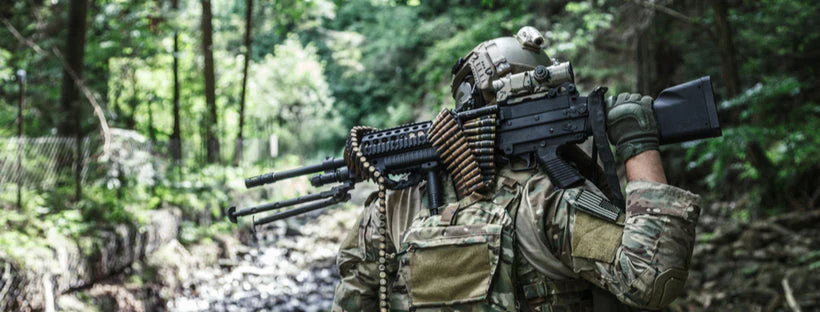
Special Operations Forces helped make MultiCam famous. Photographs of American operators in Afghanistan wearing the pattern, often combined with modern plate carriers, helmets and night-vision equipment, created a new visual archetype for the post-2001 era.
That image also crossed into popular culture. Modern military films, video games and tactical photography have made the combination of MultiCam, carbine, plate carrier and helmet almost as recognizable as the Woodland BDU was in the 1980s.
OCP: the modern U.S. Army pattern

MultiCam was not ultimately adopted as the Army's long-term commercial name. Instead, the Army selected the Operational Camouflage Pattern, or OCP, for the standard Army Combat Uniform.
The Army announced the selection in 2014 and began making OCP uniforms available in 2015. The transition ran until September 2019, with the entire Army required to move to OCP by October 1, 2019.
OCP retains much of the visual philosophy that made MultiCam attractive: greens, browns, beige and subdued transitional colors. The result is far less "digital" than UCP and much closer to the natural environment.
The current Army Combat Uniform uses OCP, and the Army also fields the Improved Hot Weather Combat Uniform in the same pattern.
For airsoft, OCP has the advantage of being visually versatile. If your local field changes from green woodland to dry grass or mixed terrain during the season, OCP remains a sensible option.
The modern U.S. military did not simply abandon woodland camouflage because forests disappeared. It moved toward patterns that could tolerate changing environments.
Special Forces: the patterns that became identities
The history of U.S. Special Forces camouflage deserves separate attention because specialist units have often been quicker to experiment.
Special operations camouflage has often been influenced by mission, deployment, procurement and personal equipment rather than a simple "one unit, one pattern" rule.
The same is true for equipment. Modern Special Operations loadouts can mix camouflage clothing with Ranger Green, Coyote Brown, Multicam or neutral-colored equipment, depending on the period and mission. That flexibility is one reason modern SOF impressions are both fascinating and difficult to reproduce accurately.
What does all this mean for an airsoft player?
The history of US military camouflage patterns gives airsoft players a surprisingly useful rule: choose the impression and environment first, then the pattern, then the equipment. A historically correct uniform can be a great choice for a themed event, while a more versatile modern pattern may make more sense for regular weekend games.
A woodland field does not automatically require Woodland camouflage. A player in modern OCP can be perfectly well concealed in European vegetation, while a Vietnam-style Tiger Stripe uniform may work surprisingly well in dense summer woodland. The key is how the colors interact with the actual terrain.
Before buying a complete loadout, consider:
Terrain: dense forest, open grass, dry scrub, mixed woodland or buildings.
Season: spring green is very different from late autumn.
Period: Vietnam, Cold War, 1990s, Iraq/Afghanistan or current-day Army.
Role: rifleman, scout, sniper or general-purpose player.
Equipment: camouflage clothing should work visually with your plate carrier, chest rig, helmet and pouches.
For a modern woodland setup, the Airsoftmania camouflage collection is a useful starting point, especially if you want to combine a conventional uniform with additional concealment equipment.
If your goal is maximum concealment rather than historical accuracy, ghillie equipment changes the equation completely. A 3D layer can break up the silhouette far more aggressively than simply changing from one printed uniform to another. Airsoftmania's ghillie and camouflage collection includes full suits, jackets, trousers and other concealment accessories.
Pros, cons and when to buy each pattern
For airsoft, the most useful way to approach the history is to turn it into a practical choice. The following US military camouflage patterns cover most of the classic American impressions players tend to build:
Tiger Stripe: excellent for Vietnam impressions, dense vegetation and specialist recon/Special Forces aesthetics. Its main drawback is historical specificity.
ERDL/Woodland: ideal for Vietnam late-war impressions, Cold War and 1980s–1990s U.S. Army or Marine setups. It is still a very usable woodland pattern today.
MARPAT Woodland: the natural choice for Marine Corps impressions from the 2000s onward. The digital pattern gives it a distinctive identity that should not be confused with Army UCP.
UCP: best bought for a specific early-2000s Army impression rather than purely for concealment. Its grey-green palette is historically interesting but terrain-dependent.
MultiCam/OCP: the most flexible modern choice, particularly for mixed woodland, grassland and transitional terrain.
A woodland player has more reason to prioritize concealment and natural colors, while a CQB player may care more about movement, snag resistance and the overall practicality of the uniform.
The same logic applies to accessories. A camouflage pattern looks much more convincing when the rest of the loadout belongs to the same visual period. A Vietnam impression with modern laser-cut nylon and a contemporary helmet may be perfectly functional for a game, but it will not look like Vietnam.
For players who want to add smaller details, even camouflage paint can make a difference. Airsoftmania's camouflage paint selection includes subdued shades suitable for adapting your appearance to different outdoor environments.

Buy if, don't buy if
The best camouflage is ultimately the one you will actually use.
Buy a historical pattern if you enjoy impressions, MilSim events, themed games or simply like the character of older military equipment. Tiger Stripe and Woodland are especially rewarding because the history behind them is immediately recognizable.
Choose OCP or MultiCam if you want one modern uniform that can cope with several types of outdoor terrain. It is a practical choice for players who do not want to maintain several complete camouflage sets.
Camouflage is not magic. It is one element of a larger system that includes movement, silhouette, light, vegetation and equipment.
Which U.S. military camouflage is best for woodland airsoft?
There is no universal winner. Woodland, MARPAT Woodland, MultiCam and OCP can all work well depending on vegetation, season and lighting. For modern mixed terrain, OCP is particularly versatile.
Was Tiger Stripe officially issued by the U.S. Army?
No. Tiger Stripe was never a standard U.S. Army issue camouflage pattern. It was widely worn by American Special Forces and other specialist personnel in Vietnam, often through local production and arrangements with South Vietnamese units.
What is the difference between Woodland, MARPAT and UCP?
Woodland is the classic four-color camouflage associated with the BDU era. MARPAT is the Marine Corps digital pattern introduced with the MCCUU. UCP is the grey-green digital pattern introduced with the Army Combat Uniform in 2004.
Is OCP the same as MultiCam?
They are closely related visually and share a similar approach to natural, transitional colors, but they are not simply the same designation. MultiCam was developed commercially, while OCP became the U.S. Army's official Operational Camouflage Pattern.